An overview of marriage, divorce and the new custody laws in Australia
By Robert Whiston FRSA, Sept 13th 2009
Every English speaking country around the globe has been trying for years to reach the point now achieved by Australia, namely the enacting of ‘shared parenting’. The goal is to make matters a little more equitable for divorced fathers and the judicial “orphaning” effect on children less severe.
In Britain, Canada, and New Zealand, for example, all attempts at a more egalitarian division of children’s time after divorce have been stonewalled using the same rehearsed argument once voiced in Australia.
Mindless chanting is fine for domestic audiences but why, if it is so impossible to arrange, can the French, Dutch, Swedes and Belgians have the wit that Anglophones lack ? Why not tell the public the truth – explain how and why it is we ‘Anglos’ can’t manage it
Shared Parenting in Australia was made possible by the introduction of Family Law Amendment (Shared Parental Responsibility) Act 2006. This reformedPart VII of the Family Law Act 1975.
The most significant aspect of this reform was the introduction of a rebuttable presumption of ‘equal shared parental responsibility’. In particular, the concurrent obligation placed on family courts to consider ‘equal time’ and ‘substantial and significant time’ arrangements where the presumption applies.
Australia’s legal reform saw the introduction of ‘parenting plans’ which it was stated in the Act would help determine what actually was in the child’s best interests.
The “child’s best interests” is both a legacy and an obstacle. No where is there a definitive criterion and no where is it anyone but 3rd party adults and professionals deciding what is in the parents’ and child’s best interests.(and at last academia and the mainstream media is beginning to recognise the anomaly). [1]
In an attempt to tackle this intellectual and philosophical deficit and reconcile parents, the Act divided considerations of the child’s best interests into two categories, 1). primary considerations and 2). additional considerations. These considerations are intended to form the basis of custody awards.
(NB. There seems to be an in-built assumption in the Act that only cases where the parents are in dispute does it necessitate them going to court for a ruling – RW).
In common with reforms in Belgium and Holland, resources were made available in Australia for the reconciliation of differences between parents and to help separating parents reach their own agreements.
At the same time as the Government implemented these legislative changes it also established Family Relationship Centres around Australia and funded other non-Government organisations (NGO) to provide parents with advice, counselling and mediation
It is interesting to note that all the topics alluded to so far have been put to the Lord Chancellor’s Dept (LCD) and the Ministry of Justice by Britain’s fathers groups since 2001 but to no avail.
It was anticipated that the majority of cases in Australia would be settled ‘amicably’ without court intervention. It was foreseen that only the more ‘intractable cases’ would reach court.
The implication of this is that whereas previously ‘the shadow of the court’ promoted sole custody arrangements with men not likely to challenge for better custody, the reforms of 2006 meant that equal and shared parenting was likely to grow, both through court awards and by off-the-balance-sheet arrangements, i.e. the shadow of the law effect.
It must surely come as a surprise to fathers everywhere that Australia’s Chief Justice suddenly decided that custody awards merited the keeping of statistics – said by a government source to be ‘a first’ for Australia’ judiciary.
The idea, apparently, was to “understand the results that were being obtained by the parties coming to court.” Why was this not being done already ? (This was a recommendation made to CAFCASS in LCD committee in 2000 by Britain’s fathers groups).
By the end of 2008 enough data had been gathered for the Australian Bureau of Statistics (ABS) to make some basic and tentative assessment. The number of finalised cases totalled 1,448 and the number where “early agreements” had been reached was 2,719 (2007 – 2008).
These judicial statistics have to be measured against the larger number that are not decided by courts, made informally in the shadow of the law (and these figures do not relate to orders made in the Federal Magistrates’ Court).
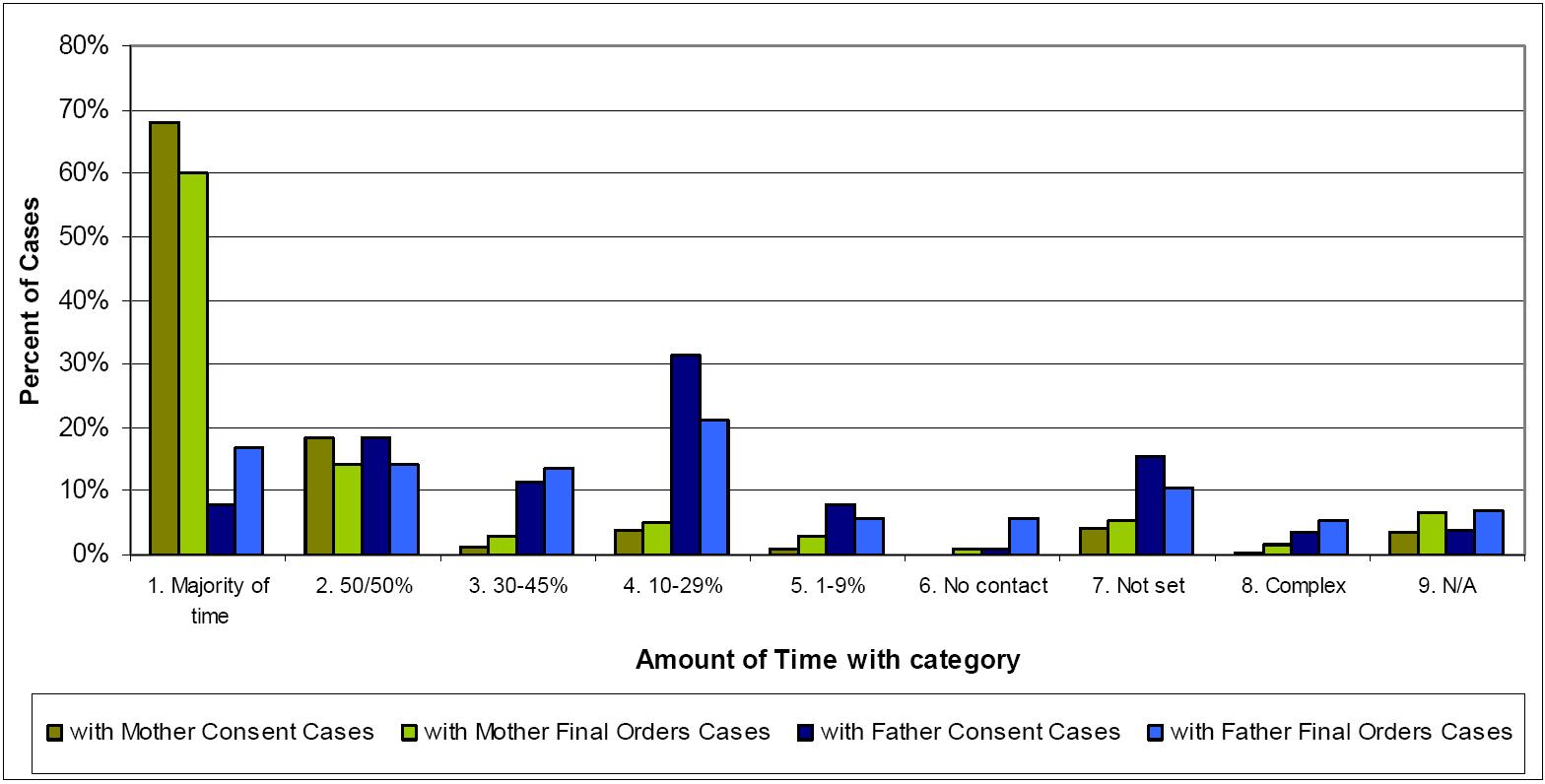
In the diagram above (Fig1; Click for enlargement) the left most columns represents with whom the child spent the majority of their time. At nearly 70% are mothers with “consent orders”. The next column in the group, at 60%, is mothers with “final order papers”. A round 8% are fathers with “consent orders” and at 17% (light blue) are fathers with “final order papers”.
The next series of columns (and much shorter) reflect awards of a 50:50 division of time between parents. In this category around 18 – 19% of parents get equal time with their children.
The subsequent categories from right to left are 3). 30% – 45%, 4). 10% – 29%, 5). 1% – 0%, 6). No contact at all, 7). no order set, 8). “complex”, 9). Not available.
(See Appendix A below for more analysis).
It would be fair to assess the first 2 years as failing to live up to the fears of mothers and women’s groups that fathers would runaway with the majority of custody awards and the majority of shared custody. If anything the transformation to equality is close to imperceptible.
Overall, the Family Court has made orders that the children spend more than 50% of time with their mother in 60% of litigated cases – but ‘60% of litigated cases’ does not mean 60% of all cases.
By way of balancing this figure, where parents can reach an early agreement it was agreed that the child spend more than 50% of time with their mother in 68% of cases.
It is probably too early to suggest that Pareto’s Law is applying in custody awards.
The Family Court made 50/50 care orders between parents in only 15% of litigated cases. However this figure rose to 19% of cases where parents had came to an early agreement to share care.
If any progress is to be made in other countries – pre-supposing that a full 50:50 share in child care is an unlikely option – then the next category is perhaps the most vital, i.e. cases where the father receives between 30% and 45% of time.
In this category of cases where the father received between 30% and 45% of the time, the Family Court made orders to that effect in 14% of the litigated cases.
In this same category the Family Court made orders that the children spend between 30% to 45% of time with the mother in only 3% of litigated cases.
In a third of litigated cases, the Family Court ordered that children spend 30% or less time with their father (Fig 2). Of the 100% of this category, the main reasons for the order included ‘abuse and family violence’ in 29% of cases (Fig 2).

Fig. 2. Fathers – when less then 30% of the time – Reasons for the Family Court to order that children spend 30% or less time with their father in a third of the litigated cases
|
Reason |
Percentage of cases |
| Abuse and family violence | 29% |
| Entrenched conflict | 15% |
| Distance/transport/financial barriers | 6% |
| Substance abuse | 5% |
| Relocation | 4% |
| Mental health | 3% |
| Childs’ views | 2% |
| Other (*) | 35% |
| * ‘Other’ includes where the reason is unknown such as; the parties consenting during the litigation process, the reason is not covered by a category, or there is multiple and complex reasons. | |
| Source: Family Court of Australia, Shared parental responsibility – Statistics in cases conducted in the Family Court of Australia during 2007–08, 2 March 2009 | |
If 29% of these 30% of cases involved allegations of abuse and family violence, this equates to approx. 9% of the total decided by courts (i.e. 29% of 30%). Where ’entrenched conflict’ is given as the reason this equates to 5% (i.e. 15% of 30%).
In 9% of litigated cases (Fig 3), the Family Court ordered that children spend 30% or less time with their mother. The main reasons for the order include mental health issues (31%) and abuse/violence. The later, at 16%, is higher than one would expect and for some reason no ’entrenched conflict’ is listed for mothers. This pushes the reader towards interpreting all conflict as male inspired.

Fig 3. Mothers – when less then 30% of the time – Reasons for the Family Court to order that children spend 30% or less time with their mother in 9% of the litigated cases
|
Reason |
Percentage of cases |
| Mental health issues | 31% |
| Distance/ transport/financial barriers | 16% |
| Abuse and/or family violence | 16% |
| Substance abuse | 7% |
| Relocation | 7% |
| Entrenched conflict | 2% |
| Childs’ views | 2% |
| Other (*) | 20% |
| * ‘Other’ includes where the reason is unknown such as; the parties consenting during the litigation process, the reason is not covered by a category, or there is multiple and complex reasons. | |
| Source: Family Court of Australia, Shared parental responsibility – Statistics in cases conducted in the Family Court of Australia during 2007–08, 2 March 2009 | |
In some states of the USA where shared parenting legislation has been adopted it has been suggested that a declined in the numbers divorcing has followed. This is not conclusively proven but tentative. Observations of a situation can also be deeply influenced by a fall in economic activity; a fall in marriage numbers, or is simply a coincidence.
Therefore, the graph below (Fig 4) should be treated with caution. The apparent fall in divorce since 2001 (itself unusually high) has been followed by further falls but the overall ‘averaged’ level, taken from 1996 to 2005, did not significantly fall until 2007.

A further word of caution in relation to Fig 4 is needed, namely that the ‘Y axis’ does not begin at zero divorces but starts at 39,000 divorces and rises to over 54,000, thus exaggerating the annual variations and could give a false first impression.
The number of divorces fell to 51,375 in 2006 and fell further in 2007 to 47,963. Whether this is a sustainable downward trend or a ‘statistical blip’ only time will tell.
It should also be added that the number of divorces granted in 2007 was 9.8% lower than five years earlier but only 6.6% lower than 10 years ago due to a peak in the number of divorces granted in 2001.The decade trend from 1998 to 2007 is shown in tabular form at Fig 5. At 47 963 there were still more divorces than there were in 1988.
Fig 5. Number of divorces granted – selected years 1988 – 2007 (Australia).
| 1988 | 1998 | 2003 | 2004 | 2005 | 2006 | 2007 | |
| No. of divorces granted | 41 007 | 51 370 | 53 145 | 52 747 | 52 399 | 51 375 | 47 963 |
| Source: Taken from “Selected divorce indicators – Australia: Selected years – 1988-2007”, ABS, 3307.0.55.001 – Divorces, Australia, 2007 | |||||||
In recent years the proportion of children caught up in their parents divorce has dropped from 57% to 49% (see Fig 6). The numbers too have fallen. This, however, could be a function of postponing childbearing until later in married life.
Fig 6. Proportion of children caught up in their parents divorce – selected years 1988 – 2007 (Australia).
| 1988 | 1998 | 2003 | 2004 | 2005 | 2006 | 2007 | |
| Proportion of all divorces (%) | 57.5 | 53.4 | 50.1 | 49.8 | 49.8 | 50.1 | 49.3 |
| Actual numbers of children | — | — | 49 850 | — | — | 48,396 | 44,371 |
| Source: Taken from “Selected divorce indicators – Australia: Selected years – 1988-2007, %, (children)”, ABS 3307.0.55.001 – Divorces, Australia, 2007 | |||||||
Looking back over the last twenty years the proportion of divorces involving children aged under 18 years has decreasing but that decline has slowed in recent years (compare Fig 6 with Fig 7).
NB. In Britain we tend to include children aged under 16 and define them as ‘dependent’. In other countries the age for used is 18 (e.g. Australia, New Zealand).
In terms of actual numbers of children affected by parental divorce only figures for 2006 and 2007 were readily accessible (Fig 6 and Fig 7). From other ABS sources it would appear that in 2001, 28,345 children had parents who divorced and in 2002 the figure was 26,820 children. [2]
Fig 7. Numbers of children affected by parental divorce 1984 – 1994
| Australia / Year | 1984 | ’85 | ’86 | ’87 | ’88 | ’89 | ’90 | ’91 | ’92 | ’93 | ’94 |
| Divorces involving children of all divorces (%) | 60.9 | 60.6 | 59.7 | 58.6 | 57.5 | 55.3 | 55.6 | 54.2 | 52.9 | 52.6 | nya |
| Actual numbers of children | 50,713 | 24,215 | |||||||||
| Source: ABS, 3307.0.55.001 – Divorces, Australia, 2002 | |||||||||||
For the first time in 20 years the proportion of divorces involving children fell below 50% in 2007 (49.3%). If this is related to Australia’s introduction of shared parenting it will be intriguing to see what future years will bring.
The Australian Bureau of Statistics then displays this trend as a graph (see Fig 8), however it should be noted that the Y axis begins at 48% and not zero%. This means that the visually dramatic fall seen in Fig 8 is really only a 10% fall, from around 60% to close to 50%.

The duration of marriages, from inception to separation, has risen slightly since 1988 (Fig 9). The duration has risen from 10 years in 1988 to 12½ years in 2006.

Fig 9. Median length to separation and divorce: Australia – 1988 – 2007. (Source: ABS, 3307.0.55.001 – Divorces, Australia, 2007)
At the same time the age at which divorces were sought also increased from 33 for females in 1988 (the key driver) to 40 in 2006 (Fig 10).
If the American predictions about the effects of shared parenting are true then this trend should be reinforced over the coming years.
Once again the Australian Bureau of Statistics have displayed the trend in the graph (Fig 10) not with a zero% Y axis but one that begins at 34,000. However, whereas earlier trend lines had fluctuations giving undue importance to a trend change, Fig 10 has consistently upwards trend lines and so more accurately reflects the changes in society.

Fig 10. Median age at divorce: Australia – 1988-2007. (Source: ABS, 3307.0.55.001 – Divorces, Australia, 2007)
It has been suggested that women would petition less for divorce if they knew (or feared) they would not automatically be awarded custody of the children. Conversely, this might encourage husbands/fathers to petition in greater numbers. However, this does not yet appear to be the case.
This is underscored by Fig 11, which gives an analysis of those petitioning for divorce. The upper line (starting at 50%) represents women applying for divorce and displays a ‘surge’ between 1996 and 2001. The middle line beginning at 38% shows male applications. Both male and female applicant trends are generally downwards, while, ‘joint applications’ emerge from relative obscurity in 1988 to a dominant position by 2006. Why this should have occurred is not clear unless it is related to some peripheral driver, e.g. legal aid entitlement.

Fig 11. Type of applicant: Australia – 1988-2007. (Source: ABS, 3307.0.55.001 – Divorces, Australia, 2007)
Postscript
Vociferous and sometimes vitriolic opposition to equality in parenting has already surfaced in Australia. It comes not from fathers but from women’s organisations which must somehow feel themselves under threat and a few academics, e.g. Jennifer McIntosh. This threat must relate to the prospect of not seeing their children quite so often and/or with not so much of the monopoly over their children that they once previously enjoyed.
Could this horror be rooted in their own fear ? The nightmare that some fathers/men might do to them what for years they have been wantonly doing to fathers ?
For academics the threat is to their reputations. Adele Horin writing in Australia’s ‘The Sydney Morning Herald’ quotes Jennifer McIntosh, a highly respected child psychologist as casting doubt on the efficacy of post divorce shared care / shared parenting. [3] Having invested so many years writing papers and authoring books to now be shown (and over the coming years proven) to have got it completely wrong is worth any manipulation of the facts – certainly until retirement. [4]
The current maliciousness towards equal parenting tends to come from those very people that have for so long demanded that Society treat them as equals.
Those that describe themselves as professional and business women are allegedly opposed to equal parenting – if there are any professional and business women in favour of equal parenting they have so far failed to step forward or counter their sisters. Yet is it not the case that shared equal parenting would mimic traditional couples inasmuch that it would give the former wife and mother, more ‘down time’, more quality time for her own personal needs, more time to focus on her career and profession and generally lower her stress levels (see mental health levels Fig 3 above) ?
The other argument ‘thread’ found on Australian websites and in the occasional feature article is one connected to the perceived risk of violence.
Since we have shown above that this applies to only about 5% of families one might be tempted to dismiss it as a comparative irrelevance. However, since it will be ‘majored’ on by opponents to equal parenting (predominantly by that splinter group in society involved with domestic violence against women, but not against men), its deserves a brief demolition. [5]
The policy of this group, perhaps best described as a ‘clique’, is to stress how Australia is a family-friendly nation, and that as such Australia should remain committed to children (note how Nationalism suddenly appears from this quarter).
The needs of children should be the paramount consideration when deciding custody (note, needs are not specified). But who decides custody in both the present and former regimes ? Adults, of course ! Children – when they are asked – uniformly say they want access to and enjoy both parents.
This clique believes the changes to equality in parenting were premised on ensuring the rights and welfare of parents (and why not, there are two parents and both have rights ?), yet they are unable to see this criticism, circular though it is, could be equally levelled at the previous regime.
Their argument then turns to the new system being awful because it adopts a “one size fits all” principle. From the statistics given above this clearly is not the case and is demonstrable nonsense.
If anything can be labelled a “one size fits all” solution it is the former regime where men were totally excluded from meaningful participation in the future lives of their own children and women almost guaranteed 100% custody.
Had women not so recklessly, routinely and gratuitously abused their position of trust and misused their ‘gatekeeping’ powers, a reform might not have been so urgently necessary.
Examination of the clique’s claim that the new law takes no account of the circumstances of individual families and individual children is rendered absurd by the above statistics depicting the division of custody and the reasons given.
Then, by focusing on the dysfunctional and troubled families (which do exist), their logic is that the new regime cannot be rolled out to those families which are not dysfunctional and not troubled, i.e. normal, as this will somehow be unfair and disadvantage dysfunctional families.
Evidently the proverbial penny has not dropped – one cannot have a “one size fits all” criticism if at the same time also complaining about the new law taking into account disadvantaged and ‘troubled families’.
By freeing up resources these troubled families are able to secure the attention and dedication that under the previous regime would have been rationed or curtailed. By implication this means that the hope among even the most dysfunctional and troubled families of a path to normality will be improved.
Critics of the new shared parenting laws prefer not to publicise how broken and defective were the previous set of laws. Papers from 10th Australian National Family Law Conference held in Melbourne (16-20 March 2002) spell out unequivocally how out of touch the model had become by 2002. [6] One speaker was of the opinion that:
“The concept of parental responsibility is past its use-by date. It should be consigned to the dustbin of legal history, like the Roman law concept of paterfamilias.
Society needs a new standard: that of family responsibility [as opposed to ‘parental responsibility’]. By this I mean that family members should be responsible for each other and that the extent of the ‘bundle’ of rights accorded to each family member should depend on the degree of responsibility exercised in practice by each member, whether such responsibility is accepted voluntarily and lovingly or imposed by the law.
The idea of family should be broadly defined to encompass disparate cultural and social models so that the general principle of family responsibility can be adapted pragmatically to specific circumstances.
Thus I endorse the German law that children are legally obliged to financially support their aging parents, with the concomitant rule (followed in Spain) that a young person should not be entitled to welfare benefits if the family can afford to provide support.
My basic premise also leads me to criticise laws, such as in France, Sweden and Germany, which prohibit a father from totally disinheriting an unrepentant prodigal son. Responsibilities conferring rights, yes, but no rights without responsibilities.
The criticism before Australia changed her custody law – and it’s a chorus in every English speaking nation – is that it would lead to the neglect of children’s rights and an increase in domestic violence. This claim is now being re-laundered in the post-legislative phase. This is a useful indicator to other countries of what they might expect should they adopt Australia’s solution.
That esoteric legion which earns it salary through domestic violence advocacy fails to mention that their concerns about rising levels of conflict between parents is unlikely to occur given that there is now less at stake or to argue about. They complain of “a very oppressive culture that desperately needs to be reviewed”, yet fail to see that only the previous regime was oppressive and created a culture of animosity and ‘winner takes all’.
Surely the ideal of such domestic violence interest groups is to eradicate “the problem” and so work themselves out of a job.
Or is it ?
Faced with unemployment would not the kind of review they seek put them back into fulltime employment ?
END
Appendix A
CASES WHERE MOTHERS RECEIVED A MAJORITY OF TIME
- In 60% of litigated cases, the Family Court made orders that the children spend more than 50% of time with their mother.
- Where parents came to an early agreement, it was agreed in 68% of cases that the child spend more than 50% of time with their mother.
CASES WHERE FATHERS RECEIVED A MAJORITY OF TIME
- In 17% of litigated cases, the Family Court made orders that the children spend more than 50% of time with their father.
- Where parents came to an early agreement, it was agreed in 8% of cases that children spend more than 50% of time with their father.
CASES WHERE 50/50 TIME WAS AWARDED
- In 15% of litigated cases, the Family Court made orders for 50/50 care between parents.
- Where parents came to an early agreement, the parents agreed on a 50/50 care arrangement in 19% of cases.
CASES WHERE THE FATHER RECEIVED BETWEEN 30% AND 45% OF TIME
- In 14% of litigated cases, the Family Court made orders that the children spend between 30% to 45% of time with their father.
- Where parents came to an early agreement, it was agreed in 11% of cases that the children spend between 30% to 45% of time with their father.
- In 3% of litigated cases, the Family Court made orders that the children spend between 30% to 45% of time with the mother.
- Where parents came to an early agreement, it was agreed in 1% of cases that the children spend between 30% to 45% of time with their mother.
CASES WHERE THE FATHER SPENT NO TIME WITH THE CHILDREN
- In 6% of litigated cases, the father was ordered to spend no time with the children.
- Where the parents came to an early agreement, it was agreed in less than 1% of cases that the father have no contact with the children.
The main reasons for the order include:
|
Reason |
Percentage of cases |
| Abuse and family violence | 38% |
| Entrenched conflict | 10% |
| Distance/transport/financial barriers | 0% |
| Relocation | 2% |
| Mental health issues | 2% |
| Other | 42% |
| * Not all categories are shown in this table therefore it does not add to 100%. ‘Other’ includes where the reason is unknown such as; the parties consenting during the litigation process, the reason is not covered by a category, or there is multiple and complex reasons. | |
| Source: Family Court of Australia, Shared parental responsibility – Statistics in cases conducted in the Family Court of Australia during 2007–08, 2 March 2009 | |
CASES WHERE THE MOTHER SPENT NO TIME WITH THE CHILDREN
- In 1% of litigated cases, the mother was ordered to have no contact with the children.
The main reasons for the order include:
|
Reason |
Percentage of cases |
| Abuse and family violence | 15% |
| Entrenched conflict | 0% |
| Distance/transport/financial barriers | 8% |
| Relocation | 8% |
| Mental health issues | 31% |
| Other | 31% |
| * Not all categories are shown in this table therefore it does not add to 100%. ‘Other’ includes where the reason is unknown such as; the parties consenting during the litigation process, the reason is not covered by a category, or there is multiple and complex reasons. | |
| Source: Family Court of Australia, Shared parental responsibility – Statistics in cases conducted in the Family Court of Australia during 2007–08, 2 March 2009 | |
GRANDPARENTS
- In 8% of litigated cases the Family Court ordered that the child spend time with grandparents.
- In 2% of cases where there was an early agreement it was agreed that the child spend time with the grandparent.
- In 2% of litigated cases the Family Court ordered that the child spend time with an ‘other’ person.
- In 1% of cases where there was an early agreement it was agreed that the child spend time with an ‘other’ person.
END
References
- Australian Bureau of Statistics, ABS, 3307.0.55.001 – Divorces, Australia, 2002 http://www.abs.gov.au/AUSSTATS/abs@.nsf/allprimarymainfeatures/FBC6FEDBB2B43180CA256FAF0071CE3F?opendocument
- Australian Bureau of Statistics, ABS, 3307.0.55.001 – Divorces, Australia, 2006 http://www.abs.gov.au/ausstats/abs@.nsf/ProductsbyReleaseDate/93C5FC5AF5651286CA2574B30017C7F7?OpenDocument
- Australian Bureau of Statistics, ABS, 3307.0.55.001 – Divorces, Australia, 2007; http://www.abs.gov.au/AUSSTATS/abs@.nsf/7d12b0f6763c78caca257061001cc588/f356dbb7ea7a96eeca256f10007b6b1a!OpenDocument; http://www.abs.gov.au/ausstats/abs@.nsf/mf/3307.0.55.001
- Baroness Deech of Cumnor DBE; Human Rights and Welfare – Do children need a father?, Gresham College – Lectures and Events, 11/05/2009 http://www.gresham.ac.uk/event.asp?PageId=45&EventId=865
- Family Court of Australia, Shared parental responsibility – Statistics in cases conducted in the Family Court of Australia during 2007–08, 2 March 2009 http://www.familycourt.gov.au/wps/wcm/resources/file/eb6b6e03325f52f/SPR_org_02_03_09.pdfhttp://www.familycourt.gov.au/wps/wcm/resources/file/eb6b6f033263e7d/SPR_org_02_03_09.doc
- Robert Whiston and Nigel Hawkes; Violence and the invisible sex; In: Straight Statistics – Tue, 15/09/2009 – 09:10http://www.straightstatistics.org/article/violence-and-invisible-sex
Footnotes
[1] “A Critical Perspective on the Welfare Principle” by Stephen Gilmore (2001). From: The Law and Social Work; Part I. See also “No yardstick for child’s best interest – It would make more sense to probe least detrimental options”, Leonard Carr, The Times, South Africa Aug 19, 2009 http://www.timeslive.co.za/opinion/columnists/article17710.ece
[2] Australian Bureau of Statistics, ABS, 3307.0.55.001 – Divorces, Australia, 2002 http://www.abs.gov.au/AUSSTATS/abs@.nsf/allprimarymainfeatures/FBC6FEDBB2B43180CA256FAF0071CE3F?opendocument
[3] “Children at risk in rise of shared care”, 4 March 2008. Sample was small – 77 court cases involving 111 children.
http://www.smh.com.au/news/national/children-at-risk-in-rise-of-shared-care/2008/03/03/1204402365352.html
[4] Compare Ruth Deech lecture http://www.gresham.ac.uk/event.asp?PageId=45&EventId=865 Ref. Gresham College Lecture, 2009, and ‘Divorce Dissent’ with her work devising easier divorce laws. See also (judge) Brenda Hogget exponent of anti-marriage, ‘Ends & Means: The Utility of Marriage’ 1980, who then marries her cohabitee of many years Prof. Julian Farrand.
[5] ‘Violence and the invisible sex’, http://www.straightstatistics.org/article/violence-and-invisible-sex
[6] International Family Law Chambers http://www.internationalfamilylaw.com/pub/10melb.html
Addendum: for the use of Richard Grenville – see comments below:


 Shared parenting
Richard Grenville
May 16, 2014
THE FLAWS IN Richard WARSHAK et al’s ASSERTIONS
The most serious flaw in Warshak’s Paper is that it makes a number of assertions but fails to consider the implications for current practices.
Few would disagree with his central assertion that: “ Warshak and his colleagues believe that society should encourage fathers to engage in the daytime and overnight care of their infants and toddlers after separation”.
Such assertion is then contradicted with the assertion that, “When parents are married, they generally share the care of their babies – diapering [nappy changing], feeding, bathing, putting to bed, soothing in the middle of the night, cuddling in the morning.
Why is it necessary to encourage fathers to do this, if as is claimed it is already happening?. Of course it isn’t happening in society in general, only probably in a small group of aspiring Lower Middle Class sub-classes. But Warshak et al take no account of this in their rse-tinted views of the world.
In those families where fathers are taking such an active role, then they are highly unlikely to seek resolution in the Family Courts to disputes regarding custody and contact, but will resolve such matters in a cooperative, responsible manner.
But what if, as in the majority of instances, the father has taken little or no interest in the child in the key early stages of the infant’s life or in his child’s care and wellbeing, as is highly common in those cases which require resolution by the Family Courts.?. Should the Court still order such shared parenting arrangement when the father lacks the necessary bonds of attachment with the child and the knowledge and skills to provide for the child’s emotional and physical needs .?.
Warshak appears to recognise this encumbrance where it is stated: “ Warshak notes that shared parenting is not for all families. Regardless of their children’s ages parents should always consider a range of factors when creating the best parenting plan”.
To assert therefore that, “To maximize children’s chances of having long lasting relationships and secure attachments to each parent, Warshak’s consensus report encourages both parents after their separation to maximize the time they spend with their children, including the sharing of overnight parenting time” is not based in the pre-existing realities of parental care in the majority of households.
Nor do Warshak et al give any consideration to the effects of “Ping-Pong Disorders’ of the emotional and behavioural damage caused to children by equal-time shared parenting whereby the emotional and psychological security and stability of children at a key point in their development is constantly being undermined and damaged.
I don’t think that Warshak et al have much credibility or merit in their arguments.
rwhiston
June 10, 2014
Dear Mr. Grenville,
As no one has answered your query it falls to me to explain what it is you have clearly misunderstood.
There is no contradiction; Warshak first states the expectations of ‘society’ and then states the ‘private life’ role of fathers today, i.e. ‘society should encourage fathers to engage in the daytime and overnight care of’ children and fathers ‘generally share the care of their babies.’
You ask, “Why is it necessary to encourage fathers to do this, if as is claimed it is already happening ?”, but if you were a man or father you would readily appreciate the incongruities of society’s expectations while recognising society’s pattern of persistently placing obstacles in the way of that fatherly involvement.
You then ask, “ . . .what if, as in the majority of instances, the father has taken little or no interest in the child in the key early stages of the infant’s life.” My answer to that is, ‘Show me the numbers !’ There are none.
The implicit assumption made by many women is that women do not walk away from their children or abuse them, but statistics show mothers are always more likely to murder and abuse their children than fathers, and mothers left alone with their children, i.e. single mothers or mothers with sole custody, abuse more frequently.
The number of women that commit such crimes is small and if that is accepted one also has to accept that a small number of fathers do walk away from their children – but one also has to ask why and what age and socio-economic groups do they come from.
To twist reality and Warshak’s meaning into recognition that ‘shared parenting is not for all families’ demonstrates a lack of experience in the delivery room and the pride felt by fathers towards their new born child (you should try it one day). And bear in mind we have many decades of experience of the alternative ‘failed’ system (sole mother custody) which presumably would be your default preference.
It always comes as a surprise to people that England did once enjoy shared or joint custody until 1990 when the 1989 Act accidentally killed it off. In those pre-1989 days upwards of 30% of children custody awards were joint and therefore gave extended periods, including ‘sleepovers’, to both parents. So why do we think this is now so novel an idea and at the same time so dangerous for children these days ?
It is pretty clear you are an unreformed supporter of ‘attachment theory’ in its earliest and crudest form. Ainsworth and Bowlby have all moved on, and so too has the bulk of the social sciences but your view represents a throwback.
You speak of the possible emotional and behavioural damage caused to children by equal-time shared parenting – as if being deprived of one parent does have the same or worse effect ? Tripp’s Exeter Report was one of the first to highlight the inner grief felt by children upon the ‘disappearance’ of their father. How damaging is that ?
To parents and children all this ‘dancing on a pin head’ and hair-splitting by academics is fine but irrelevant – they have to deal with real life (outcomes), and right now they want a better deal. Children don’t want to have to wait until they are 18 to see as much of their father as ‘they’ choose. Nor do they want to find they have lost touch over the years and have to spend even more years finding their father who has been blocked for years by mothers and the courts from having reasonable access and time with their child.
I can only remind you of the considered view of 111 world experts, namely that,
1. “A broad consensus of accomplished researchers and practitioners agree that, in normal circumstances, the evidence supports shared residential arrangements for children under 4 years of age whose parents live apart from each other.”
2. “Sufficient evidence does not exist to support postponing the introduction of regular and frequent involvement, including overnights, of both parents with their babies and toddlers.”
3. “There is no evidence to support postponing the introduction of regular and frequent involvement, including overnights, of both parents with their babies and toddlers.”
In short, I find your suggestions wide of the mark, lacking experience, and unrelated to the topic. Warshak not only has credibility on his side but he also has common sense – both attributes you seem to lack – and so I can give you no credence but seek to disabuse you of some very muddled thinking.
Richard Grenville
June 14, 2014
Dear Mr Whiston
You certainly have a very distorted and perverse view of the world through the narrow prism of the supremacy, inalienability, and infallibility of male rights to power and control over females and children.
I must say however that your misguided, whimsical musings are excellent entertainment.
I don’t think that many people would disagree with Warshak’s statement regarding the need for father’s to be engaged in a supportive role in the care of babies. Providing of course they can be restrained from attending the golf course and pub. If it was happening, then Warshak would have no need to state it. Where for example are these fathers who, according to your conjectures, have such tremendous interest in their offspring?.
http://www.thejournal.ie/readme/mother-and-baby-home-fathers-1513983-Jun2014/
And what of the 800,000 UK fathers who evade paying over 1.5. million pounds in child support and presumably take no interest in their children’s lives, probably numbering over a million children?. Are those fathers concerned that their children may be grieving their absence as claimed by Tripp, or is it more likely they will be extremely angry and alienated by their fathers that they live in dire poverty as their mothers cannot afford the basics of life enjoyed by other children.?.
And you know very well that governments don’t collect statistics on the involvement of fathers in children’s lives, so your question is amusingly rhetorical.
The principles of emotional attachment and the horrendous effects of maternal deprivation as highlighted by Bowlby, Ainsworth, James and Joyce Robertson have never been disproven nor discredited so they hold just as true today as when they were first advanced. They informed the Tender Years principles used by the Family Courts post-1975 until the aggravations and atrocities by the Father’s Rights movement began and judges and lawyers and Court Reporters became fearful of them. (One judge and a judge’s wife murdered, bombings of lawyer’s cars, faeces and threats sent through the post to CAFCASS workers and lawyers etc etc). So now no judge or lawyer dare to oppose the demands of psychopathic, vengeful fathers in those Courts and comply to their demands.
In fact an extension of those findings of Bowlby et al are often in evidence in Courts today when psychologist consultants assert that there is “emotional enmeshment” between mothers and children.
It was not an appeal to reason which led to shared parenting, but the engendering of a climate and culture of fear within the legal system. So the psychopathic, vengeful fathers can continue their persecutions and tortures of their victims, when they are given the powers and control by the Courts to continue.
Again there is little argument against the three points made by the Warshak supporters, and those arrangements apply in the vast majority of cases where separated parents act in a reasonable, responsible manner and reach agreement between themselves. But cases which come to the Family Courts are not those cases – they come to the Family Courts precisely because one or other of the parents are not prepared to be reasonable and responsible. Very often there has been years of violent assault involving child abuse and so those principles outlined by Warshak cannot be applied in such cases.
Clearly you are embittered and vengeful from your personal experiences which are deeply affecting your ability to be objective and impartial in these matters and to understand the wider picture, which has little relationship to your personal circumstances. That is why you cling so desperately to any straw blowing in the wind such as the Warshak claims
rwhiston
January 8, 2015
Sadly for you, Miss “Richard Grenville”, Richard Warshak has far too much class and integrity to bother with your snide and supine remarks.
And sadly too for you, 110 of the world’s leading experts agree with him, which leaves you in a lonely minority of 1 or 2.
Richard Granville
January 9, 2015
The most recent paediatric research on the crucial importance of the Mother/ Child Bond of Attachment. I’m afraid that the tide of research is moving away from Warshak and yourself and recognising children’s primary developmental needs and you are increasingly becoming a backwater. Maybe this will stop those Family Court judges deciding on split-custody of infants and babies and requiring mothers to express breastmilk to meet the babies needs while with the father, as well as older infants who are caused such severe traumatic anxiety during such separations. There can be few fathers who would want to see their children suffer such life-time developmental damage and impairment, simply to pursue the attainment of their own selfish rights.
http://www.dailymail.co.uk/health/article-2054393/Bad-news-dads-Babies-share-mothers-bed-age-good-hearts.html
rwhiston
January 13, 2015
You are a persistent little so-and-so, aren’t you, Miss ? “The tide is moving away” you suggest. Well let’s look shall we ? In Sept 2002 we have “Experiments in Living: The Fatherless Family“, by Rebecca O’Neill (Civitas): on Feb 5th 2005 we had “Unmarried families are more likely to fall apart” by Alexandra Frean, Social Affairs Correspondent, The Times, http://www.timesonline.co.uk/article/0,,2-1471297,00.html: in 2007 we had “Parenting style influences child ‘development and social mobility” which i have cited below, and lets not forget the Gov’ts, “Longitudinal Study of Young People in England: Waves One to Seven, 2004-2010” published only 2 years ago in 2012.
All the above rebut in some shape or form all that you insist is either true or valid and even CASE and the ESRC have kindly weighed in against your position so let me quote you :- “. . . . Parenting style influences child development and social mobility” – – Good quality relationships between parents, and between parents and their children can make a significant difference to young people’s satisfaction with their family situation but no-one can yet assert with certainty what actually works in terms of changing behaviours.
” . . . Fathers’ involvement is associated with a range of positive outcomes for children including educational and emotional attainment, and protects against later mental health problems.
There is room for developing policy aimed at closing the inequality gap in child development, and to do this programmes need to be more effective in improving developmental outcomes in disadvantaged children compared with their advantaged peers.” – – “Parenting style influences child ‘development and social mobility’ http://www.esrc.ac.uk/_images/parenting-style-social-mobility_tcm8-20071.pdf
And you want to stop this favorable and positive input into children’s lives ? Why ?
Richard Granville
January 20, 2015
Of course those studies emphasise the important role which fathers have in intact families as secondary caregivers, and they are essential in supporting the primary caregivers, the mothers. In regard to the first Paper you cite, it has since been shown that where mothers re-partner and again receive the support of an adult male figure who supports and assists her in the care of the children, and make a “Favourable and positive input” into the children’s lives, then there are only marginal differences in children’s developmental outcomes.
So the conclusion must be that an adult male figure, whether biological or non-biological, can make a positive contribution to children’s developmental outcomes, where they provide positive help and support to the primary caregiver, the mother.
This occurred in in great numbers after the Second World War when thousands of biological fathers were killed, and mothers re-partnered in order to obtain support and assistance with the children or single-handedly brought up their children. I would suggest that that generation, who are now the `Baby Boomers’ and in retirement, were highly successful in a great many fields, including national politics and law.
These studies you quote, cannot be related or applied to situations where couples have separated, especially where matters come before the Family Courts for resolution of custody and contact issues. Such separations have usually followed years of a dysfunctional relationship with acrimony and animosity and in many cases, there has been emotional, psychological, and financial abuse and intimate partner violence.
So your quote that “Good quality relationships between parents, and between parents and their children can make a significant difference to young people’s satisfaction with their family situation but no-one can yet assert with certainty what actually works in terms of changing behaviours” does not apply in such circumstances, especially when parents have spent vast amounts of money and time tearing each other apart in the adversarial cock-fighting pits of Family Courts.
Separated fathers then use the Family Courts to obtain custody and contact with the children in order to punish the mothers for rejecting them as inferior and inadequate as fathers, or to continue with the violence and abuse (most mothers murders by fathers or partners occur after separation) or to evade child support.]
The issue regarding the children of single mothers and their future care and welfare is primarily plagued by an inadequacy of income to meet their needs, very often having to rely on Welfare benefits which only allow them to live at bare subsistence level.
These are the major deficits and flaws in those studies which you quote and which severely limit their application and they are therefore of little value.
It is very unfortunate Whriston, that you appear to naively accept such studies without any form of critical appraisal, as long as they appear to give a little weight to your argument. Rather like a drunk uses a lamppost, for support rather than enlightenment.
The same applies in your ill-considered support for Richard Warshak, who is a major promoter of Parental Alienation Syndrome, the bastard creation of R.A. Gardner and which has been widely discredited for its complete lack of scientifically conducted studies and empirical data. And of course, Gardner went on to declare his sympathies for paedophiles and saw nothing wrong with adults having sexual relations with children. Thankfully, Gardner took his own life by grotesquely stabbing himself to death. That is why PAS is now frequently referred to as the Paedophile’s Defence against allegations of child sexual abuse, and has been completely banned from use in Australian Family Courts, although some CAFCASS workers and psychologists do still try to present it to Family Courts here in the UK, and an assumption can only be made that they, like Warshak, share Gardner’s views.
That is again where the tide is moving away from Warshak and yourself, stuck with discredited and outdated theories and studies with obvious deficits and flaws.
I hope this helps you to better understand this complex subject.
Richard Granville
January 28, 2015
Absolute proof to support RWhiston’s claim that “” . . . Fathers’ involvement is associated with a range of positive outcomes for children including educational and emotional attainment, and protects against later mental health problems.”.
http://www.msn.com/en-au/video/watch/the-disgraceful-dad-caught-out/vi-AA8FBzk?ocid=mailsignout
rwhiston
June 19, 2014
Dear ‘Richard,’
Thank you for taking the time to write such a fulsome post. I am at least pleased to hear that you find my writing and factual reporting ‘whimsical musings and excellent entertainment’ but, of course, they also serve to educate those that do not have shuttered minds. So I am pleased you are not suffering from that particular atrophy even though you may disagree with me on certain aspects.
If you don’t think that many people would disagree with Warshak’s statement regarding the need for father’s to be engaged in the care of babies, why then do you describe an article which supports Warshak’s general view (while questioning the career ‘investment’ of opponents such as McIntosh), as somehow viewing matters through the narrow prism of the supremacy, inalienability, and infallibility of male rights to power and control over females and children.
Don’t you think that if anyone holds on to power and control over families and children – and demonstrates it daily – then it is the divorced wife or the separating cohabitee and women (and men like you ?), who oppose a fairer share ? I have no idea what circles you move it but suggesting fathers’ predominant preference is to attend golf courses and pubs is little dated, and resorting to stereotypes to makes a point is certainly gauche.
Relying on a politician’s article (Marcella Corcoran Kennedy, of the Fine Gael party), written for an Irish newspaper is not quite the same as relying on science and facts. So while your URL was a temporarily interesting diversion, it as not a useful one.
You then ask about “the 800,000 UK fathers” who you say evade paying over £1.5 million in Child Support. The answer couldn’t be simpler for you – just look in the official Tables. Lets first put it into context The Child Maintenance and Enforcement Commission, reported in 2010 that it had collected £1,141m in CS in the 12 months to March 2010 of which only £147m was “in arrears” (approx 10% see http://www.childmaintenance.org/en/pdf/qss/QSS%20March10.pdf ). I would not worry too much about the £1.5 million as new powers given to the CMEC means they can go after such fathers even when they are dead and buried to recover the money from their surviving widows and children to pay the state.
The exact phrase of “the 800,000 UK fathers” who you say evade paying over £1.5 million in Child Support” was posted to me by someone called Ragnvald on a forum and he/she did not disclose its source either. By contrast you will see I use traceable citations whenever I can. Can I also add that it is not clear if the 800k is an annual figure or a cumulative one since the CSA was launched in the early 1990s ?
The reason why so large a numbers of fathers pay CS and why a seemingly large figure remains unpaid, is due to the fact that only about half of the parents-fathers (49%) are in employment (perhaps if female employment as not so highly promoted this would improve payments levels ? Now there’s a thought !). The balance was comprised of 8% self-employed non-resident parents and 43% of unemployed non-resident fathers.
You use the term ‘evade’ which has overtones of culpability, but actually it is more a case of avoiding payment by being unable to pay. Can’t pay as opposed to won’t pay.
Answered
The figure of £1,141 million (£1.1 billion) paid in CS perhaps answers your query about the “ . . . majority of instances” where the father takes little interest in the child. At best it can be argued that in only 10% of cases would this attitude prevail (i.e. £147m vs. £1,141m).
You then ask a self-answering question, namely, “ . . . should the courts order such shared parenting arrangement when the father lacks the necessary bonds of attachment with the child and the knowledge and skills to provide for the child’s emotional and physical needs?”
Well, if he is not allowed to form an attachment it is a moot point. But where a bond exists why should he and the child be deprived of each others company after divorce simply because of the behaviour of a minority of fathers and the ideological blockage by some women’s groups ? And in circumstances where you say the father has not shown any interest in his child he is unlikely to apply for shared parenting, is he ? What could be done here is to improve the 40% drop-out-rate which is now accepted by all parties, including all governments, that 40% of fathers lose contact with their children due to mother-obstructionism in the initial years.
This last point touches on your assertion that “governments don’t collect statistics on the involvement of fathers in children’s lives.” This is untrue though I readily admit they do not do a very good job of it at the moment.
But to return to Child Support matters which seem to interest you more than children’s happiness, to further illuminate the situation for you I enclose part of a Table (Table G2.07). The source is the UK ‘Social Security Statistics’ which are available from 1996 onwards though they ceased to be collected in this manner in 2009 (and also please look at Table G2.08).
You will see from the trend that since the early days (here 1996 is used), the analysis showed those who paid and how much. In this particular year there were 395,500 assessments, and 127,500 fathers had so low an income they qualified for Income Support; and a further 23,300 were unemployed or sick, or on disability benefits; with a further 27,000 on other benefits or because they were at school or college and had no income.
You will see in the first column the amount paid to the CS Agency and in the 2nd column how many. Thus 129,200 paid nothing of which 87,700 were on income support.
Even those unemployed and receiving dole money (11,400) had deductions made of between £4.80 and £10.00 p/w. And those on low incomes (Inc Supp) paid £4.80 in 38,800 of instances.
Although this Table is truncated the range of weekly payments spans £0.0 to £4.80 and up to £120 p/w. NB. If it proves impossible to post the Table with this reply I will post it separately near the footnotes.
As for ‘attachment theory’, I suspect you may be behind the curve among experts on that point. Even Bowlby has admitted he got his first version wrong and that attachment is not solely maternal as he first thought. So on that fine point, the cited authors have been ‘disproved and discredited’ by more modern science (ref. Sir Michael Rutter).
I am afraid you will always get threats and intimidation – and that has been true in all walks of life throughout history so pointless picking out fathers as if they are unique. Indeed, mothers and women are just as bad. Erin Pizzey, the woman who opened the first Refuge had her pet dog killed by radical feminist when she criticised their antics and only a few weeks ago a conference in Detroit was nearly cancelled for fear of violence – again by radical feminist (see http://fundanything.com/en/campaigns/campaign-for-free-speech).
Finally, if it were even remotely true that “. . . no judge or lawyer dares to oppose the demands of psychopathic, vengeful fathers . . . . . and comply with their demands” there would be no need to campaign for better fathers rights, would there ?
I hope this helps you.
Richard Granville
January 23, 2015
And this, Mr Whiston, is what your guru Richard Warshak so strongly believes in.
“……. family courts make extensive use of psychologists in researching and adjudicating child custody. There is arguably no branch of the legal system where psychological theories — including some that are highly controversial — are more influential. And critics say the courts’ less than rigorous approach to investigating allegations of child abuse is formalized in one such theory, which is widely used by evaluators and attorneys: the concept of Parental Alienation Syndrome (PAS).
PAS was coined by Richard Gardner, a child psychiatrist affiliated with Columbia University, to describe what he believed was a form of brainwashing that took place in the context of divorce proceedings. According to Gardner, the condition arises when a parent — usually, but not always, the mother — “programs” a child to hold delusions of sexual abuse by the father. Armed with this theory, Gardner hired himself out as an expert witness in family courts across the country, appearing on behalf of men seeking to discredit sex-abuse allegations.
Yet many questioned the scientific basis of his work. Gardner’s research consisted for the most part on his personal observations as a clinician, rather than systematic, peer-reviewed studies. PAS has never been accepted into the Diagnostic and Statistical Manual of Mental Disorders, the psychiatrist’s bible of known conditions. The syndrome has also been denounced by professional groups including the National Council of Juvenile and Family Court Judges and the American Psychological Association Presidential Task Force on Violence and the Family, which view it as a ploy for obscuring a court’s inquiries into allegations of child abuse.
“Alienation is being used in almost every case where a child is taken from a safe parent and placed with a dangerous parent,” says Kathleen Russell, executive director of the Mill Valley–based Center for Judicial Excellence, a family-court reform group. “It’s a legal tactic.”
Gardner’s ideas are also controversial in light of provocative statements he made criticizing society’s condemnation of pedophiles, and seeking to portray adult-child sexual contact as normal. “Pedophilia has been considered the norm by the vast majority of individuals in the history of the world,” he wrote in the 1992 book True and False Accusations of Child Sex Abuse. In the same book, he suggested wives of pedophiles masturbate in order to increase their own sex appeal, reasoning that “increased sexuality may lessen the need for her husband to return to their daughter for sexual gratification.”
Few defend Gardner’s more outlandish stances, but his theory of parental alienation has persisted, in part because he trained psychologists and family court officials in California and other states prior to his suicide. (Gardner punctuated an unusual career in an unusual way, stabbing himself to death with a steak knife in 2003.)”
http://www.sfweekly.com/sanfrancisco/california-family-courts-helping-pedophiles-batterers-get-child-custody/Content?oid=2180699&storyPage=4
Richard Grenville
February 2, 2015
This study becomes immensely pertinent to this issue. It rightly draws attention to paedophile fathers, which has tended to be ignored while focus has been on stranger paedophiles. Family Court professionals and judiciary have tended to consider it unconscionable that fathers rape and sexually their children or that it occurs with such frequency. It firmly exposes the deceptions of Gardner and Warshak that child sexual abuse allegations are made in an attempt to `alienate’ children. It is to be hoped that Family Court personnel give far more credence to such allegations in the future and that children are respected as competent witnesses and their testimony as reliable and credible, as is stated in the principles of law in the Evidence Acts.
http://www.adelaidenow.com.au/news/south-australia/criminology-study-finds-focus-should-be-on-paedophile-fathers/story-fni6uo1m-1226811544275?nk=98643526130b58eaad8e4aaf31ad0a92