

Coronavirus concerns see family courts rush through applications linked to COVID-19 ~Police data shows no big jump in domestic violence during isolation
Coronavirus concerns see family courts rush through applications linked to COVID-19
By political reporter Matthew Doran
Updated about 2 hours ago

PHOTO: Some custody-sharing arrangements have been affected by border closures. (Unsplash: Annie Spratt)RELATED STORY: Police say no spike in domestic violence in SA, despite woman's alleged murderRELATED STORY: Unused mobile phones set to save lives during coronavirus crisisRELATED STORY: Winner of $50,000 writing prize dismantles 'the lazy old lies we associate with domestic abuse'
Urgent cases relating to children caught up in parenting disputes will be rushed through the courts within 72 hours, as the Family Court and Federal Circuit Court report a rise in calls for help during the coronavirus crisis.
Key points:
- The courts will hear matters in a dedicated COVID-19 list
- There has been an almost 40 per cent increase in urgent applications to the Family Court
- Restrictions have disrupted some custody arrangements, and led to an increased risk of domestic violence
There has been a 39 per cent increase in urgent applications filed in the Family Court, and a 23 per cent increase in the Federal Circuit Court over the past month. Cases set to be fast-tracked include disputes where there is an increased risk of family violence as a result of social restrictions put in place to curb the spread of COVID-19. The two courts, which share responsibility for dealing with family law matters, will have a dedicated process to deal with cases needing immediate attention in place from the middle of next week. Will Alstergren, Chief Justice of the Family Court and Chief Judge of the Federal Circuit Court, said court staff were "working tirelessly" to ensure Australian families were supported during the national emergency. Coronavirus restrictions have added to the complexity of some parenting orders around the country, which set out the terms in which shared custody or supervised contact with children are managed. The courts had received advice from women's legal services about an increase in the number of people coming to them for help during the emergency. The closure of state borders has left some children unable to travel between the homes of their parents or guardians, and the courts may need to step in to organise other arrangements while such travel bans are in place. Coronavirus update: Follow the latest news in our daily wrap."Applications that are eligible to be dealt with through the COVID-19 list, especially those involving issues of risk and family violence, will receive immediate attention and will be triaged by a dedicated registrar who will assess the needs of the case and allocate it to be heard by a judge within 72 hours of being assessed," Chief Justice Alstergren said in a statement.
"It is important that these urgent COVID-19 applications are closely managed on a national basis so that they can be heard as swiftly as possible given the unprecedented circumstances we are facing."
The courts may also have to step in when a parent or guardian, or the child themselves, have tested positive for coronavirus, and usual parenting orders cannot be followed.
Many parents working through changes without courts
Paul Doolan, chair of the Family Law Section of the Law Council of Australia, said the announcement would be welcomed by his colleagues, who had seen a rise in the number of new clients seeking urgent advice, along with existing clients needing further support.
Coronavirus questions answered

Breaking down the latest news and research to understand how the world is living through an epidemic, this is the ABC's Coronacast podcast.Despite the increase in applications to the courts, Mr Doolan said many families that had parenting orders in place were trying to sort out their differences without the need for judges to get involved. "I think a lot of people are trying their very best to be sensible and reasonable, and try and place alternate arrangements, if the existing ones are simply impracticable because of the health and safety concerns at the moment," he said. "There are, undoubtedly, outlier cases where people are not acting reasonably, or they're using these circumstances as an opportunity to perhaps obtain what they see as a strategic advantage. "Most people realise this is a situation which is once in a lifetime for — hopefully — all of us, and they're trying their best to make arrangements to put the best interests of their children first."
Your questions on coronavirus answered:
- What's behind the COVID-19 'second-week crash'?
- Where do people who are homeless go during COVID-19?
- What went wrong in Singapore?
Mr Doolan argued the fact the new arrangements had been put in place showed the Family Court and Federal Circuit Courts were not properly funded, and hoped it would reignite debate about how the courts are resourced. Some contact centres, where some parents are allowed to see their children under supervision, have also closed during the outbreak. Making applications with the courts has also been simplified during the emergency, with paperwork lodged electronically and hearings held using videoconferencing. The courts' dedicated COVID-19 list will run for at least three months
Police data shows no big jump in domestic violence during isolationSydney Morning Herald
By Sally RawsthorneApril 23, 2020Police data shows there was no major increase in reports of domestic violence during March, despite the implementation of social distancing measures that experts feared would fuel violence at home. Data analysed by the Bureau of Crime Statistics and Research shows 2678 domestic violence-related assaults were recorded by NSW Police in March, compared to 2632 in the same month in 2019.
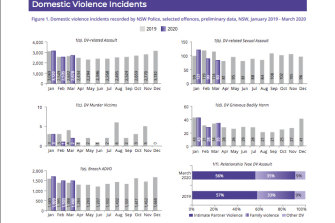
“It is possible the figures are stable because isolation strategies have affected the willingness or ability of people experiencing domestic violence to seek assistance from police,” the report warns.E-Safety commissioner Julie Inman Grant said abusers may be trapping their victims at home and limiting their access to phones or computers, meaning they are unable to report abuse.