

'Potentially dangerous': One Nation's tactics at family law inquiry concern women's advocates
Discredited themes, including that men’s aggression is caused by partners who seek to deny access to their kids, have drawn most of the attention this week

Sat 14 Mar 2020 08.09 AEDTLast modified on Sat 14 Mar 2020 16.39 AEDT
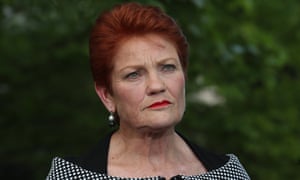
The only authorised video stream of this week’s federal parliamentary hearings into Australia’s family law system was broadcast on Pauline Hanson’s Facebook page. The camera was operated by Hanson’s aide James Ashby, the stream captioned like an official broadcast but published with hundreds of unfiltered live comments from apparently aggrieved fathers, who called witnesses and MPs “man-hater” and “dirty snake”. In the shadow of the murders of Hannah Clarke and her three children, expert witnesses have told the inquiry that reform to family law is increasingly urgent to better protect mostly women and children, primarily from men who perpetrate acts of coercive control and domestic violence. But in its first full week, most of the attention of the inquiry has been taken by debating discredited tropes: that women lie about domestic violence; that men’s aggression is caused by partners who seek to deny access to their kids. A succession of fringe interest groups has been invited to give evidence. On Thursday the head of the Men’s Rights Agency, Sue Price, made claims that there had been an “increasing number” of false domestic violence allegations made by women. The Greens senator Larissa Waters challenged Price about why she did not believe women’s accounts. “When I talk to probably 5,000 men each year for 26 years, I think I get a pretty good handle on who is telling me the truth,” Price said. “No, I don’t talk to the women, we’re a men’s rights agency. I talk to many, many men who tell me that … lies have been told.” Waters then brought up the evidence of multiple experts and researchers who had told the inquiry that the existence of a domestic violence order or unproven allegation did not provide any benefit in family court proceedings. “I don’t think the experts know what they’re talking about on these issues,” Price responded.
Hannah Clarke would have found it ‘impossible’Zoe Rathus, an expert on family law and domestic violence at Griffith University, told the inquiry the legislated presumption of equal shared parental responsibility had proved “extremely dangerous” and acted to prevent people from airing allegations of domestic violence in the family court. AdvertisementRathus said that danger was particularly apparent in situations like the one faced by Clarke, where the behaviour of her estranged husband, Rowan Baxter, had been abusive and controlling but not physically violent. “Hannah Clarke was allowing Baxter to see the children on a regular basis,” Rathus said. “[The presumption in favour of equal shared parental responsibility] would have been part of all of the information that she will have been given. It would have been almost impossible for her to have resisted doing that. “And if she had, it would have been very possible for him to accuse her of being an alienator, particularly as this is not a case that would have been described as aggressive violence. We know that family violence can be most dangerous when it isn’t necessarily aggressive.”
Hanson said the murders of Clarke and her children were horrific and “should never happen. But it’s on both sides.” “I read your report and it is all about women,” she told Rathus. “Do you agree that there are men that are aggrieved? That there are men that are victims of domestic violence? That there are men that, you know, are taking their own lives?” Rathus responded: “I would prefer if you didn’t ask me if I admitted things. I’m not really here to admit things, senator. I’m here to present my research. I’ve been working in this area since 1981. “The statistics are very clear – that domestic violence is something that is very gendered and that violence in the home happens more often by men towards women.”