

University justice stacked against men
Bettina Arndt Columnist Australian Financial Review
May 30, 2019 — 11.46amAccording to the angry mob that targeted Cardinal George Pell, one of his key mistakes was the Melbourne Response, a scheme designed to offer justice to sexual abuse victims without establishing legal liability. They were outraged the scheme circumvented proper legal processes, denying victims their day in court and allowing perpetrators to avoid public disgrace. Yet there’s no public outcry about Australian universities getting into the same business – setting up their own schemes for dealing with sexual abuse investigations by side-stepping proper judicial processes.
At least four Australian universities now have regulations in place for investigating and adjudicating allegations of rape on campus, removing normal legal protections available to accused young men in criminal court and using the lower civil standard of “balance of probabilities” to find them guilty.
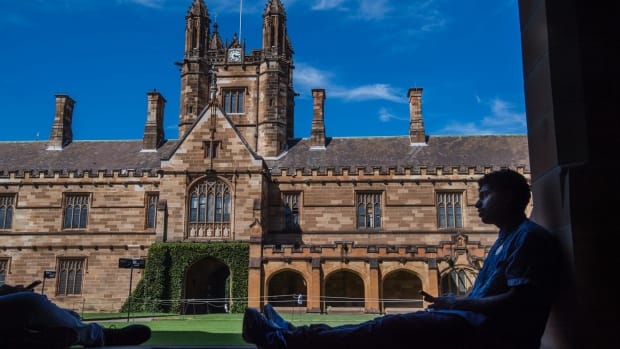
But rather than letting perpetrators off the hook, this scheme aims to do everything possible to nail accused young men, even those who would never be convicted in a criminal court. Such as the couple who’ve had a drunken hook-up – where the male student will inevitably be deemed a rapist, according to compulsory sexual consent courses being run by our universities. Or the girl suffering regrets sex, humiliated because her lover wasn’t interested in an ongoing relationship. It’s notoriously difficult to get juries in such date rape cases to send accused young men to prison. That’s why many feminist activists think this move by the universities to adjudicate allegations of rape on campus is a marvellous idea. Labor's shadow minister for education Tanya Plibersek, for example, promised to strip funding from higher education institutions that don’t take serious action against sexual abuse and harassment. Serious action means the universities getting involved in such cases. Just look at what happened at the University of Tasmania. Talk about an orchestrated campaign. It started with lobbying from student activists following the release of the Australian Human Rights Commission survey, highlighting high levels of “sexual violence”. The report said 51 per cent of all university students reported sexual harassment "on at least one occasion in the year studied" – most of this was unwanted staring – and glossed over tiny rates of sexual assault (only 0.8 per cent per year).
Yet according to police reports collected by the NSW Bureau of Crime Statistics, university campuses are roughly 100 times safer than the rest of the community. There were 14 campus sexual assault reports to police between 2012 and 2016 years compared with 24,498 across the state.
Related
Sexual abuse at university 'too prevalent' The compliant local media then campaigned for UTAS to do more about this shocking situation. Next came the appointment of two “social justice” lawyers to review the issue, who recommended the university establish a new investigation and discipline process – which in turn was applauded by the activists. And voila, last December UTAS announced new regulations establishing a “student conduct” committee to investigate whether, on balance of probabilities, sexual assault complaints had been substantiated before determining appropriate outcomes.
Kangaroo courtsThe result amounts to kangaroo courts, says Greg Barns, a Hobart barrister who has defended clients involved in UTAS disciplinary processes. He says the university is failing to offer accused students many of the normal legal protections available in our criminal system. These usual protections include being given full details of the accusations or having the right to cross-examine their accusers. Barns points out the consequences for a person accused of a sexual assault in today’s febrile climate are horrific. “It is career-ending irrespective of the eventual outcome. Vigilantism, media and social media harassment and serious adverse consequences for the individual’s family are all, sadly, part and parcel of life for a person accused of such an offence,” Barns says. I’ve interviewed on YouTube two young men who have been subject to such biased, unjust investigations – a PhD student at the University of Adelaide and another thrown out of his college at the University of Western Australia. Numerous other cases are emerging, including one where the university withheld the accused student’s degree for over a year. It’s easy to see where this is all heading, given what’s happened in America where the Obama administration required all publicly-funded American universities to establish tribunals adjudicating sexual assault cases using similarly low standards, which morphed into a “believe the victim” alternate justice system.
Huge legal payoutsThe costs for this exercise have been immense, with a string of huge legal payouts on top of the escalating costs of administering this quasi-judicial system. Last year, a US Court of Appeals case ruled that Boston College should pay over $US3 million ($4.3 million) in compensatory damages after the university had failed to provide a “fair disciplinary process” for a student accused of sexual assault. This was the 100th judicial decision in favour of students who sued their colleges in such cases – with the resulting publicity being extremely damaging for the universities. Now the Trump administration has moved to ensure due process rights in colleges, a move greeted favourably around the country.

I recently sent detailed evidence of the American situation to members of the Sydney University Senate, another of the universities recently signed up to this foolishness. Vice-Chancellor Michael Spence is assuring them that he’s had proper legal advice that his system will be fine and dandy. No doubt Obama’s lawyers made similar comforting noises. There are many questions that should be asked of our publicly-funded universities before they head further down this path. Surely investigations by staff unqualified in criminal law could interfere in chances of a just outcome in any future criminal case, for both the accuser and the accused. Even if there is no finding in such an investigation, the consequences can be severe – a law graduate student, for instance, is required to report being subject to any such investigation in their legal admissions application. Will there be any scrutiny of the integrity, character and competence of those people given power to determine outcomes in these cases? Given these new policies have been introduced by stealth, with no public scrutiny, what procedures are in place to ensure the relevant committees act consistently and transparently in making their judgments? “History teaches us to be suspicious of specialist courts and tribunals of all description. They are usually established precisely because proceedings conducted in accordance with normal judicial standards of fairness are not producing the outcomes that the government wants,” wrote former University of Queensland Law professor Geoffrey de Q. Walker in his 1988 book The Rule of Law. Universities are under immense pressure to move further in this direction. Woe betide the consequences for male students denied proper justice. Universities are very safe places for most young women. Bettina Arndt is one of Australia's first sex therapists and a noted commentator on broader social issues. She is a regular on the speaking circuit and appears on television and radio. Connect with Bettina on Twitter.