

|
The Irony of Identity Politics
How the Cultural Left Fails to Reconcile Truth and Fairness
|
|
|
|||||||||||||||
It’s true that outcomes for certain demographic groups are worse than others. American-Indian and Alaska Native groups, for instance, have some of the most damning outcomes in education, physical and mental health, employment, and living in fatherless homes. Black Americans have some of the worst outcomes when it comes to homicide deaths. Yet the way outcomes are presented are predicated on identity hierarchies that conflate data as a way to encourage pseudoscience and particular narratives instead of deeper investments in truth seeking.
  |
Mentioning, for instance, that blacks account for the majority of homicide deaths per 100,000 population is certainly true, but not acknowledging that black males account for 87% of those black deaths misses the greater factor, male, by nearly seven times over. It also misses that American Indian-Alaska Native, Hispanic, and Native Hawaiian-Other Pacific Islander males die from homicide at higher rates than any female groups.
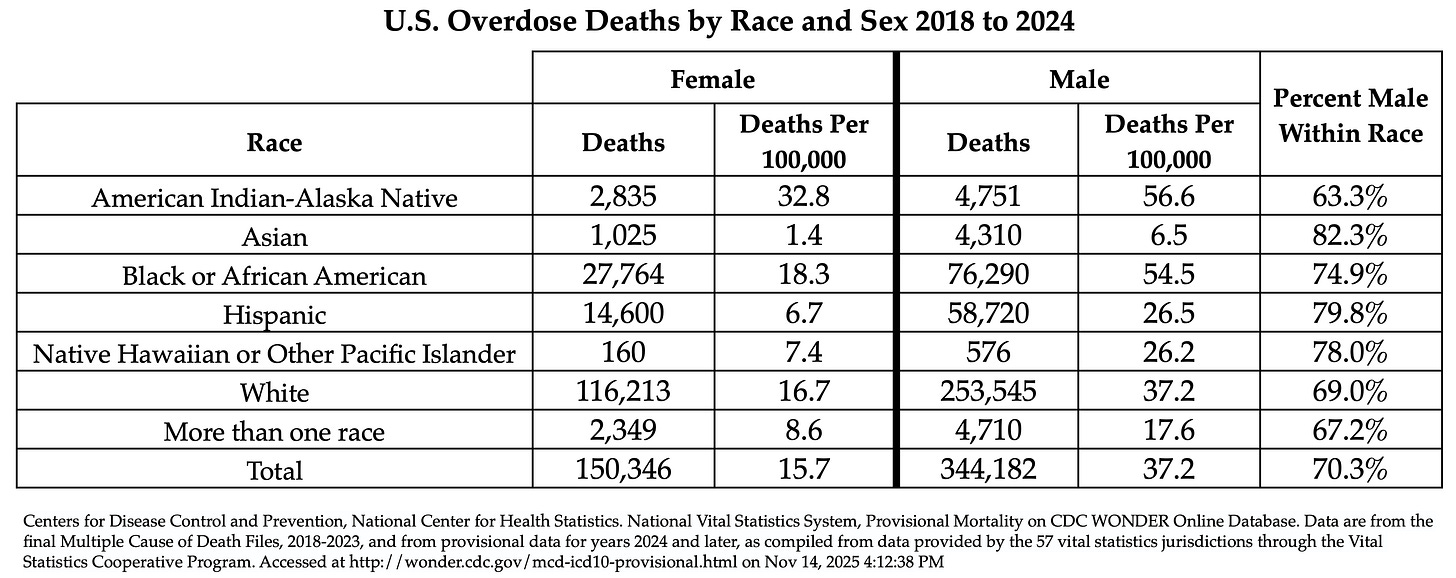
When looking at overdose deaths, more white males die than all female groups combined. Additionally, white males account for 51 percent of all overdose deaths across all racial, ethnic, and sex demographics combined—while only accounting for 29 percent of the U.S. population.
This muddling of demographic groups by factors like race are part of the data conflation trap that nearly always works to subjugate male outcomes. Certain demographic groups are faring worse than others, but it is not because of their race and more accurately for reasons like fatherlessness, poverty, and the way society ignores the deeply rooted sex differences that impact nearly every factor of life, from the kindergarten classroom to the political decisions at local, state, and federal levels. There is a commingling of factors of course, but the one constant is male and female difference and the moral and ethical failings to recognize it.
Culturally left groups will rarely, if ever, post the types of tables like the ones above or acknowledge some of the data because it exposes uncomfortable truths. Some might argue that the tables above use a type of identity politics of their own by identifying male and female groups by race and sex. That interpretation misses the point and exposes the irony of the identity politics crowd.
Listing groups by race and sex, for the cultural left, is selective for those groups that fall within a certain hierarchy. This approach is seen most notable by the use of the word “intersection” found predominately in academia, media, and government. It is used to identify predetermined “marginalized groups” and the funding of government agencies, non-profits, and non-government organizations whose purpose is to promote that status quo, maybe do some good, and help some at the expense of others—who are often suffering in greater proportions and in violation of equality under the law.
In my own work, I’ve used the word intersection as a way to differentiate outcomes. For instance, I’ve said many times that “any studies into deaths of despair or educational outcomes that do not disaggregate at the intersection of race and sex are always misleading.” It is like the presentation of homicide and overdose deaths as race issues when they are most notably, but not exclusively, a male issue connected to male and female brain difference in the functional sense and triggered or exacerbated by the social fallout of fatherlessness and the socioeconomic consequences that lead people to poorer communities and poorer schools—schools that go on to ignore those sex differences and perpetuate the male gender-gap in education at all socioeconomic levels.
Much of my research has included tables that compare male and female outcomes across many different demographic groups. Although those tables show that males of all races are faring worse than their female counterparts and often across racial lines, the tables never deny female suffering. Recognizing that Hispanic/Latino males accounted for 80% of overdose death in their ethnic group (58,720 male deaths) over the past seven years when compared to their female counterparts does not deny the 14,600 Hispanic/Latino female overdose deaths and the need to look at the circumstances that led to their deaths. The same practice is not employed when female groups are the primary subjects of articles—often completely dismissing or minimizing male outcomes, something I’ve written about in a number of pieces. The same happens in our political processes: this is what I mean by intentional moral and ethical failings by those in power who actively work against the common good under the guise of identity politics.
- How false allegations led to the deaths of 17-year-old-boys from different continents
- A Rebuttal to the Wall Street Journal
- Afghan Boys: The Suffering of the Innocent
- Boys are Fastest Growing Victims of Human-Trafficking
Why Sex Difference Matters and How The Cultural Left Capitalizes on Identity Politics and Denial
When we start seeing male disparities across every racial and ethnic groups, it should force us to look at the mechanisms of male nature that make boys and men more susceptible to external factors and the approaches designed to help them. Poverty, divorce, abuse, mental-illness in the home, fatherlessness, and other adverse experiences are triggers that impact males and females differently and the outcomes are the proof of that different impact—not the denial of one over the other. And those outcome differences are too easily compounded by the lack of attention or the wrong type of attention and support by academia, media, and government.
For those of us who are researching reasons and solutions to the issues males face, we are directly looking at female outcomes as well and trying to understand the mechanisms of female nature that make them susceptible to troubling outcomes.
For the cultural left, this sex difference approach is problematic unless it benefits one of the identity groups in the hierarchy. Recognizing male and female difference (sex differences) is the left’s Achilles heel. Sports and educational practices are prime examples of this phenomena.
Men who call themselves trans and the policymakers who allow them to compete in women’s sports is an example of the type of sex-difference denial that impacts males and females. It hurts females by creating an unfair playing field and it hurts the majority of men who do not support this action but are blamed for it. The good news is that some of this is changing. It is not coming, however, from the cultural left but from policymakers on the right. The recent decision by U.S. Olympic officials and the National Collegiate Athletic Associate (NCAA) to keep men who call themselves trans out of women’s sports is an important step in the right direction that was initiated by policies on the right.
One of the cruelest things of all, however, is telling a child that he or she was born in the wrong body and imposing cultural pressures under the guise of “gender-affirming care,” promoting instead the Essentialism Bias in Transgender Medicine. This problem erupted in our schools with educators and school boards fighting to keep information from parents when children reported or were coerced into ideas around sex and gender—manipulating children to believe they could actually change their sex. This is impossible.
Educational institutions have aggressively embraced the denial of sex-difference and excluded parents from their children’s mental health crisis at a time when children are particularly vulnerable and need parental support. The children going through this experience are depressed, mentally ill, or simply going through a phase that—if anything—requires the support of loving parents and not transitioning.
Identify politics is a major reason the stories of detransitioners are rarely a part of mainstream media outlets; it’s the reason few know that males who claim themselves as trans females are still three times more likely to commit suicide than females who claim themselves as trans males, a ratio that mirrors males and females who do not deny their biological sex. The identity politics of our time attempts to replace truth with fiction, too often at the expense of children and male nature.
I am reminded of a scene in Lois Lowry’s The Giver. Jonas, the protagonist, is going through the natural experience of puberty and the feelings that come with it. The society, called the Community in the novel, gives him pills to suppress his puberty. Eventually, Jonas stops taking the pills so that he can experience life and all its emotions. His manhood is restored, giving him the strength to preserve life in the most heroic manner, saving a child.
Harming children at the expense of a cause is nothing new. Gloria Steinem feared that supporting equal parenting-rights would “undermine its political base” and drive membership away from the National Organization of Women (NOW). That decision knowingly subverted the needs of children in order for NOW to gain a political foothold.
The Mechanics of Prejudice Coming from the Cultural Left that Ignore the Principle of Parsimony
Engaging in male and female difference is difficult for the cultural left because the ideology is wedded to an oppressor mindset that has served as the bread and butter of their political platforms. After all, what society would allow a state to have a commission on women and girls and a commission on LGBTQ while not having a commission on boys and men when male outcomes are, statistically, more troubling? Ironically, I think many on the left do not believe in these ideologies but are simply goose-stepping to the beat of political pressures and party allegiance at a time when the cultural left needs a political reset and more bold policymakers willing to push back.
Some may argue that this reset on the left will come in the form of boys and men’s commissions, which are sorely needed—commissions designed to educate policymakers, inform policy, and actually measure outcomes that identify best practices in areas like education, mental health, and social services to name a few. I have my doubts, however, that the left can pull it off because the left will, more than likely, fall back on identity over truth and fairness for fear of unsettling the base.
Even given the opportunity, culturally left institutions tend to compound problems by employing social norms theories that portray males as inherently flawed, toxic, privileged, unruly, and a host of other socially constructed misrepresentations of male nature and masculinity. The struggle to move beyond the politics of masculinity to healthy male development is real because selective identity is the base element of the cultural left’s platforms, particularly when it comes to men—but not only men.
The same ideological approach happened with anti-Semitic protests on college campuses, the underlying principal being the drive to identify a group of people as oppressors as a way to gain solidarity and promote causes and ideologies over moral and ethical responsibilities. Equality under the law applies to everyone—not the predetermined. When tens-of-thousands of college students across the country are chanting “from the river to the sea,” something has gone terribly wrong. When academics, policymakers, and media outlets are demonizing male nature as a whole, white males in particular, or promoting the notion of low-testosterone males (a comorbidity by the way) as symbolic models of masculinity, something has gone horribly wrong.
This is how the mechanics of prejudice work. Camille Paglia warned against the rhetoric that ignores the “men [who] have sacrificed and crippled themselves physically and emotionally to feed, house, and protect women and children. None of their pain or achievement is registered in feminist rhetoric, which portrays men as oppressive and callous exploiters.” This has been, sadly, much of the rhetoric in academia, media, and government.
The real challenge, though, is moving beyond identity politics and the default practice on the cultural left that relies on identity for its existence. The left struggles to even discuss sex and gender as different concepts as part of a larger precept to identify favorables and unfavorables—oppressors and oppressed. And by gender, I’m specifically referring to the cultural construct and not the biological reality of sex, male and female—XY and XX.
The cultural left has tried to erase sex and replace it with identity—often ignoring the truths that define our being—not our potential. By doing so, equality under the law is not bound to any principle of parsimony and instead operates from a subjective prejudice and the irony of identity politics that follow.